
New open-source curriculum advances equitable health data research

Health Data Research Network (HDRN) Canada has launched a free, open-source online curriculum designed to help researchers, data professionals, community partners and organizations better understand how systemic oppression shapes the collection, access and use of health data.
Developed by HDRN Canada’s Inclusion, Diversity, Equity & Accessibility (IDEA) Team, the IDEA Unlearning Club curriculum explores topics such as racism, privilege and oppression, and connects these concepts to the health administrative data lifecycle. Through self-paced online modules and short explainer videos, participants examine how historical and systemic inequities can influence data practices—and how those practices can be improved by incorporating IDEA.
We need to intentionally unlearn inaccurate and harmful narratives so that we can use administrative data ethically and responsibly, and avoid generating research that reinforces historical harms ~ Dr. Amy Freier
The curriculum is one of the first initiatives to emerge from HDRN Canada’s IDEA Strategy, developed through a six-month consultation process involving staff, leadership and member organizations across the network. “After months of consensus building, a shared vision for IDEA within HDRN Canada emerged,” said Dr. Amy Freier, HDRN Canada’s IDEA Team Lead. “Together we identified potential barriers to implementing IDEA and developed strategies to address them.”
One of those strategies is Learning & Unlearning, which recognizes that many social systems—including those that shape the way administrative data are collected, accessed and used—have been influenced by colonial structures and systemic bias. [source] “We need to intentionally unlearn inaccurate and harmful narratives so that we can use administrative data ethically and responsibly, and avoid generating research that reinforces historical harms,” said Dr. Freier.
The Learning & Unlearning Strategy aims to establish a set of core IDEA competencies for people working with administrative data. These competencies will help assess existing knowledge, identify learning gaps and build a stronger foundation for equitable data stewardship. Inspired by the British Columbia Office of the Provincial Health Officer’s Unlearning & Undoing White Supremacy and Racism Project, the Unlearning Club curriculum begins with foundational concepts before connecting them directly to the administrative data environment. Participants explore how IDEA principles apply throughout the research process—from data collection and stewardship to data access, analysis and knowledge translation.
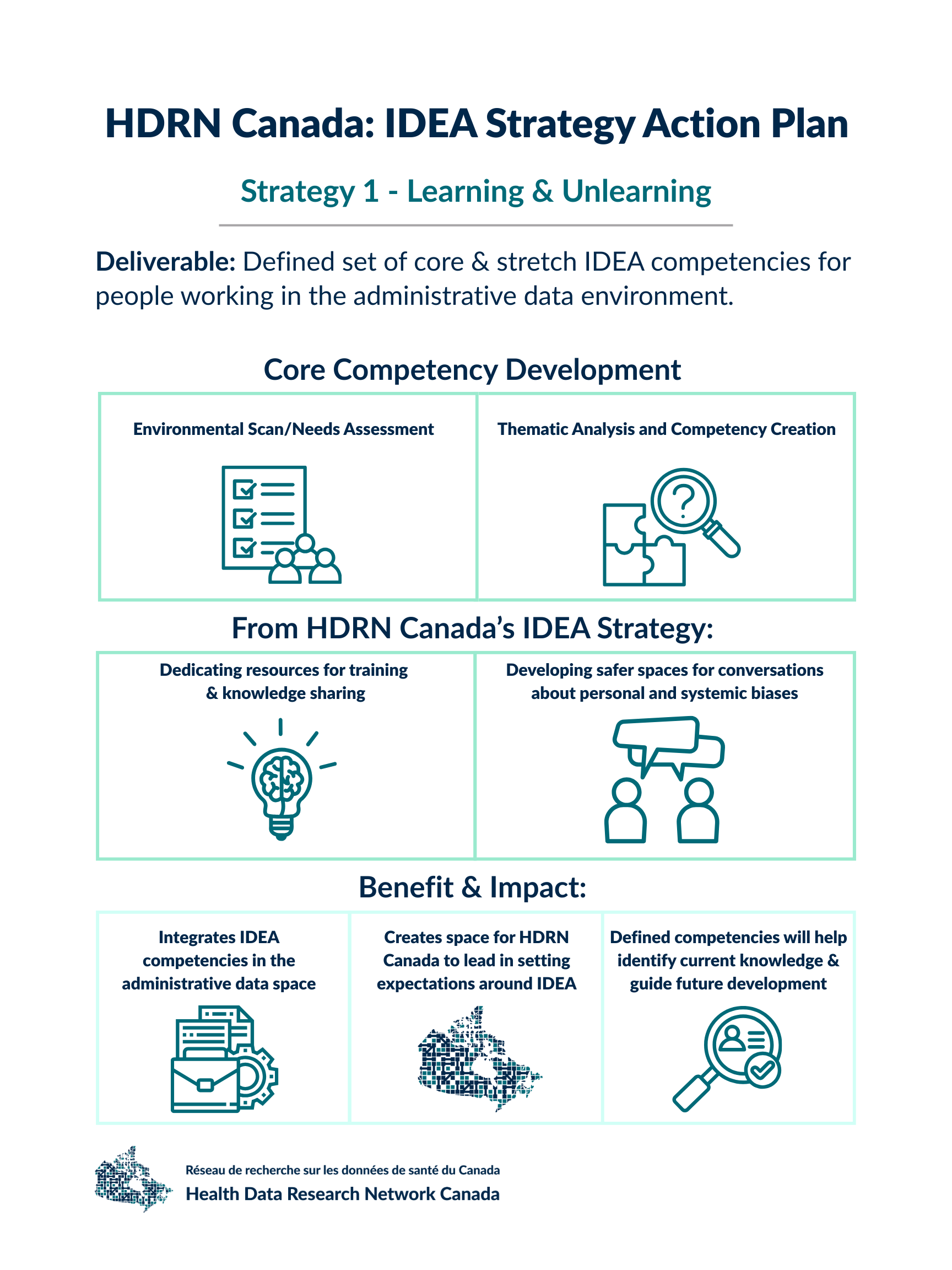
Each module includes practical resources in a variety of formats, allowing participants to learn at their own pace. “The modules provide the knowledge, skills and reflection needed to support inclusion, diversity, equity and accessibility in the administrative data space,” said Dr. Freier. “We hope people will use our curriculum to start their own Unlearning Club and begin their own journey of learning and unlearning.”
By making the curriculum openly available, HDRN Canada hopes to encourage broader conversations about equitable data practices and support organizations across Canada in strengthening the responsible use of health data.