
Advance Health. Avoid Harm. Data & AI That Don’t Hurt the Communities You Serve

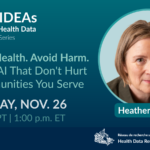
Data and artificial intelligence can accelerate health impact. They can also accelerate harm, at population scale. Health researchers use data and AI tools to clean administrative data, predict outcomes and allocate scarce resources faster. But if equity values aren’t explicitly built into those steps, you’ve outsourced judgment to tools that don’t share your mandate. The cost of “neutral” data and AI is inequity at scale. AI governance alone is not enough to correct this. You can’t make tools perfectly good – but you can make them measurably less harmful. Drawing on the We All Count Data Equity Framework, Heather Krause shows how to translate equity commitments into operational data and AI practices across the health data life cycle.
About the Speaker:
Heather Krause is a data scientist with more than two decades of experience, who stands at the intersection of rigor and responsibility. She is the founder of We All Count, a globally respected data science team dedicated to ensuring that data, the tool increasingly used to allocate resources, shape policy and determine futures, does not quietly reproduce inequity.
Heather works with organizations to embed equity directly into the DNA of their data products: from how data are collected and analyzed to how they are interpreted and ultimately used to make decisions that affect lives. This is not about optics or checked boxes. It is about redesigning systems so they work better, fairer and more truthfully.
About the Series:
The Big IDEAs About Health Data Speaker Series brings together leading voices from across research, policy, health care and the public sector to explore how administrative data can be used to advance health equity in Canada. Through thought-provoking presentations, speakers examine the responsible use of disaggregated data—including sex and gender, race and ethnicity, disability, income, housing, language and other social determinants of health. They also spotlight emerging research methods and data research practices that embed inclusion, diversity, equity, accessibility and community perspectives into algorithms, distributed analytics, community involvement and equity assessment tools.
Missed a session? Watch recordings of past webinars and explore the ideas shaping the future of equitable health data research.